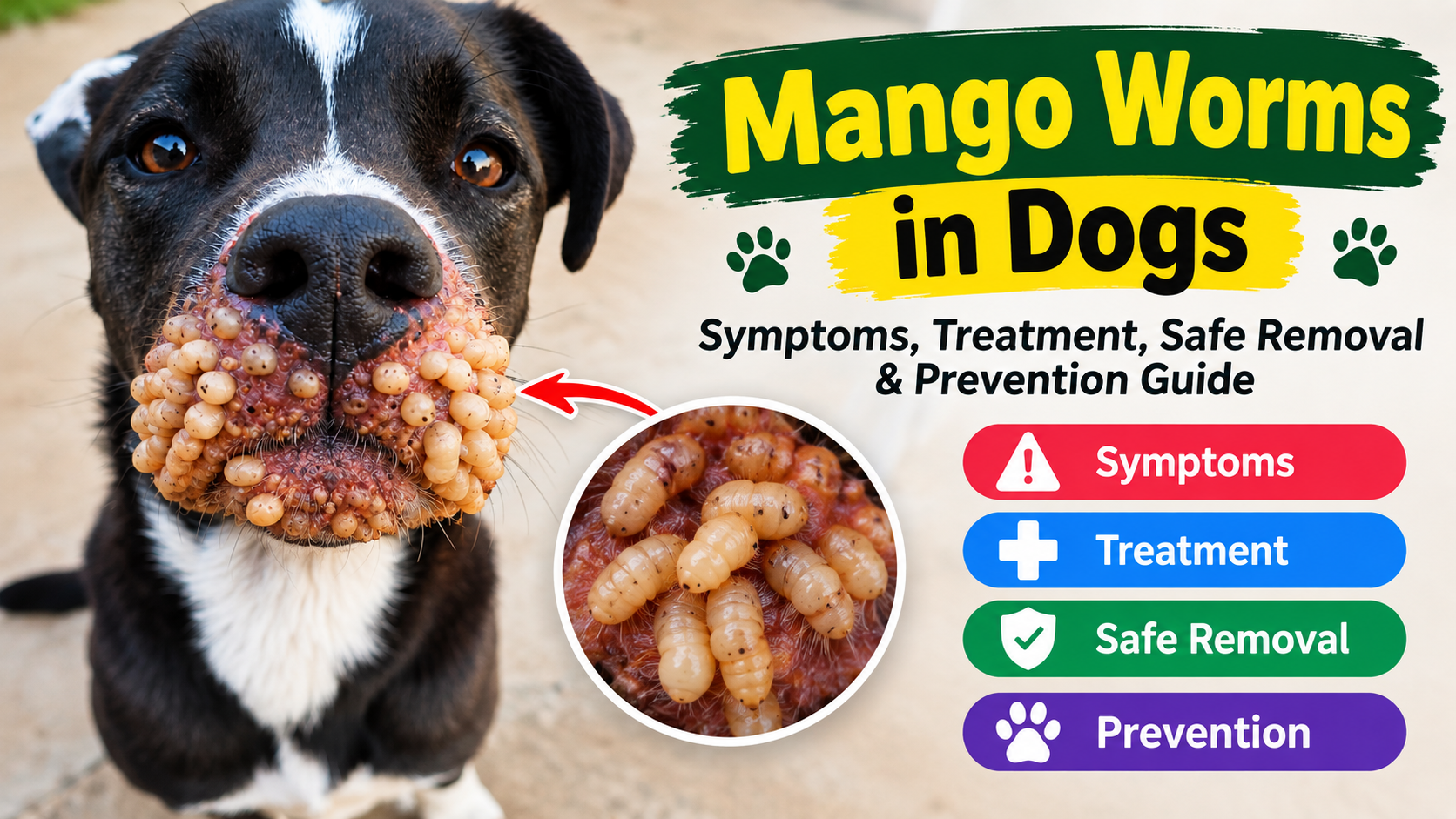
Mango Worms in Dogs: Symptoms, Treatment, Safe Removal & Prevention Guide
If you notice a small lump, swelling, or unusual opening in your dog’s skin—especially after travel or outdoor exposure—you may wonder whether it could be mango worms. Mango worms are the larvae of the African tumbu fly (Cordylobia anthropophaga), a type of fly that can cause a skin infestation called furuncular myiasis.
Mango worms are particularly associated with parts of sub-Saharan Africa, although cases can occasionally be identified in animals that have traveled from endemic regions. Dogs are among the animals that can develop these infestations. (Merck Veterinary Manual)
The good news is that mango worm infestations can be treated. However, attempting to squeeze or remove a larva incorrectly can injure your dog or leave part of the larva behind. For this reason, veterinary assessment is the safest approach, particularly when there are multiple lesions, deep larvae, infection, or significant discomfort.
What Are Mango Worms in Dogs?
“Mango worms” is a common name for the larvae of the Tumbu fly. Despite the name, they are not intestinal worms and are not caused by eating mangoes.
The adult Tumbu fly lays eggs in suitable environmental conditions, particularly sandy soil contaminated with animal feces or urine. The larvae can then penetrate the skin and develop beneath it. Dogs are among the animals that can serve as hosts. (Merck Veterinary Manual)
Once inside the skin, the larva develops within a small cavity. A characteristic feature is a central breathing opening through which the larva obtains oxygen and through which fluid may drain.
Where Do Mango Worms Usually Affect Dogs?
Mango worm lesions can occur in several parts of a dog’s body.
Commonly reported areas include:
- Feet
- Tail
- Genital region
- Armpits
- Other areas with relatively thin skin
Dogs with thin, soft skin may be more suitable hosts for the larvae. (Merck Veterinary Manual)
The exact location can vary, so checking your dog’s entire body after outdoor exposure is important.
10 Symptoms of Mango Worms in Dogs
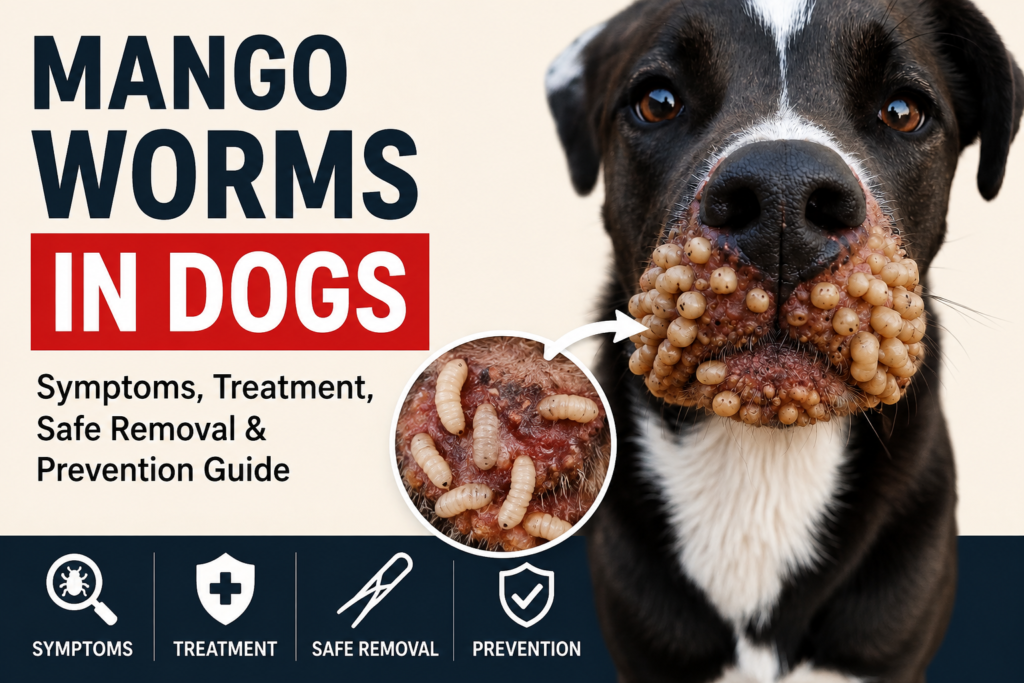
Recognizing the signs early can make treatment easier.
1. Small Red Bump
An early infestation may appear as a small red or irritated spot on the skin.
The lesion can initially look like an insect bite or minor skin irritation.
2. Firm Skin Nodule
As the larva develops, the area may become a noticeable raised lump or boil-like nodule.
This is one of the characteristic appearances of Tumbu fly infestation. (Merck Veterinary Manual)
3. Small Central Opening
A particularly important clue is a small hole or opening in the center of the swelling.
This opening allows the larva to breathe.
You may also notice occasional movement around the opening.
4. Fluid Discharge
The lesion may produce clear, bloody, or pus-like fluid.
The fluid can contain waste material produced by the developing larva. (Merck Veterinary Manual)
5. Excessive Licking
Your dog may repeatedly lick the affected area because of irritation or discomfort.
Constant licking can further damage the skin and increase the risk of secondary infection.
6. Scratching or Biting
Some dogs may scratch or bite around the affected area.
If your dog suddenly focuses intensely on one particular spot, examine the skin carefully.
7. Swelling
A localized swelling can become more obvious as the larva grows.
Multiple larvae can cause more extensive swelling and inflammation. (Merck Veterinary Manual)
8. Pain or Sensitivity
Some dogs may become sensitive when the affected area is touched.
A dog that normally enjoys being handled may pull away, growl, or become uncomfortable when you touch the lesion.
9. Hair Loss Around the Lesion
Hair around an inflamed skin nodule may become matted, broken, or fall out.
This can make the lesion easier to notice.
10. Fever or General Illness
Severe infestations can cause more significant illness. Merck Veterinary Manual notes that heavy infestations can produce marked swelling and edema, and larvae can penetrate deeply and cause substantial tissue damage. (Merck Veterinary Manual)
A dog that becomes weak, feverish, depressed, stops eating, or appears seriously unwell should receive prompt veterinary attention.
How Are Mango Worms Diagnosed?
Diagnosis is usually based on the appearance of the skin lesion, the dog’s travel or geographic history, and identification of the larva.
A boil-like swelling with a central breathing pore can raise suspicion of Tumbu fly infestation. Definitive identification can be made by examining an extracted larva. (Merck Veterinary Manual)
This is important because several other conditions can produce lumps, wounds, or larvae-like material on a dog’s skin.
Your veterinarian may therefore need to distinguish mango worms from:
- Abscesses
- Other fly larvae
- Botfly larvae
- Infected wounds
- Cysts
- Other parasites
- Foreign bodies
Mango Worms in Dogs Treatment
Treatment focuses on removing the larvae and caring for the affected skin.
The appropriate approach depends on how many larvae are present, how deeply they are located, and whether there is secondary infection.
For Tumbu fly infestation, veterinary references describe removal of larvae from their skin cavities. The lesion may be treated in a way that blocks the larva’s breathing opening, encouraging it to emerge, followed by careful extraction. (Merck Veterinary Manual)
After removal, the area needs to be cleaned and monitored for infection.
Your veterinarian may also recommend additional treatment if there is significant inflammation, tissue damage, or secondary infection.
Can Mango Worms Be Removed at Home?
This is where dog owners need to be especially careful.
Although veterinary literature describes techniques for removing Tumbu fly larvae, DIY extraction is not recommended as a first choice, particularly if you are unsure what parasite you are dealing with.
Do not:
- Dig into the skin with a needle.
- Cut the skin yourself.
- Crush the larva.
- Forcefully squeeze the swelling.
- Pull aggressively with unsterilized tweezers.
- Apply random pesticides or insecticides.
- Use household chemicals on the lesion.
The goal is to remove the entire larva without causing additional tissue damage.
If a larva ruptures during extraction, material can remain in the tissue and complicate wound management. Veterinary professionals can also determine whether more larvae are present and whether the wound needs additional treatment.
What Is the Safest Removal Method?
For a suspected mango worm, the safest option is to have your veterinarian perform or supervise removal.
Veterinary references describe using a thick occlusive substance over the breathing opening to restrict oxygen and encourage the larva toward the opening, followed by careful extraction. (Merck Veterinary Manual)
However, this information should not be interpreted as a recommendation to perform the procedure yourself. The correct approach depends on the lesion, the parasite, its depth, and your dog’s condition.
Professional removal is particularly important when:
- There are several larvae.
- The lesions are deep.
- Your dog is in significant pain.
- The area is infected.
- The lesion is near the eyes, mouth, or genitals.
- Your dog will not remain still.
- You are uncertain whether it is actually a mango worm.
What Happens After Mango Worm Removal?
After the larva has been removed, the wound should be properly cleaned and monitored.
Your veterinarian may recommend:
- Wound cleaning
- Topical treatment
- Pain management
- Antibiotics if a bacterial infection is present
- Follow-up examinations
- Additional parasite treatment when appropriate
It is important to make sure all larvae have been removed.
If several larvae were present, there may be additional lesions that were initially hidden beneath the dog’s coat.
Can Mango Worms Kill Dogs?
A small number of properly treated mango worm lesions may resolve successfully. However, severe infestations should never be ignored.
Merck Veterinary Manual reports that Tumbu fly larvae can penetrate deeper tissues and that extensive infestations can cause substantial damage. (Merck Veterinary Manual)
The risk is greater when numerous larvae are present, treatment is delayed, or secondary infection develops.
Seek veterinary care quickly if your dog has multiple skin nodules, significant swelling, severe pain, weakness, fever, loss of appetite, or rapidly worsening wounds.
How to Prevent Mango Worms in Dogs
Prevention focuses heavily on reducing exposure to the environment where Tumbu flies lay their eggs.
1. Keep Your Dog’s Living Area Clean
Promptly remove feces from the yard and keep your dog’s sleeping area clean.
Tumbu flies can lay eggs in sandy soil contaminated with feces or urine. (Merck Veterinary Manual)
2. Clean Urination Areas
Where practical, keep areas where your dog regularly urinates clean and manage contaminated soil.
Environmental hygiene can reduce suitable breeding conditions.
3. Reduce Fly Exposure
Use screens and keep dogs away from areas with heavy fly activity when possible.
This is particularly important in regions where Tumbu flies are established.
4. Check Your Dog’s Skin Regularly
Regularly examine your dog’s:
- Paws
- Armpits
- Belly
- Tail
- Groin
- Ears
- Neck
- Between the toes
Early detection can help prevent a small lesion from becoming a larger problem.
5. Keep Wounds Clean
Open wounds can attract various fly species.
Merck Veterinary Manual recommends appropriate wound care and preventing animals with wounds from being exposed to flies. (Merck Veterinary Manual)
If your dog has a wound, keep it clean and follow your veterinarian’s wound-care instructions.
6. Maintain Regular Grooming
Regular brushing and grooming make it easier to notice unusual bumps, swelling, wounds, or parasites.
Keep the coat clean and prevent severe matting.
7. Avoid High-Risk Areas When Possible
If you live in or travel through a region where Tumbu flies are common, ask a local veterinarian about practical parasite-prevention strategies for your dog.
Geographic history is particularly useful when diagnosing Tumbu fly infestation. (Merck Veterinary Manual)
Are Mango Worms the Same as Regular Dog Worms?
No.
Mango worms are fly larvae living in the skin, while common intestinal worms live inside the digestive tract.
For example, roundworms, hookworms, and whipworms are gastrointestinal parasites with very different life cycles and treatments.
Mango worms are a form of myiasis, meaning infestation by fly larvae.
This distinction matters because regular intestinal deworming medication should not be assumed to treat a larva living inside the skin.
Can Mango Worms Spread From Dogs to Humans?
Tumbu flies can affect multiple mammalian species, including humans and dogs. (Merck Veterinary Manual)
The main concern is environmental exposure to the fly and its larvae rather than simply being around an infected dog.
If your dog has a confirmed infestation, practice good hygiene, wash your hands after handling affected areas, and follow veterinary instructions for wound care and environmental control.
If a person in your household develops a boil-like skin lesion after travel or outdoor exposure in an endemic region, they should seek medical evaluation.
Mango Worms vs. Other Dog Skin Parasites
Not every bump containing a larva is a mango worm.
Dogs can also be affected by other fly larvae and parasites. For example, Cuterebra larvae, sometimes called warbles, occur in North America and have a different life cycle from Tumbu flies. (Vca)
This is why identifying the parasite correctly is important before choosing treatment.
A veterinarian can examine the lesion and determine the most appropriate course of action.
When Should You See a Veterinarian?
Contact your veterinarian promptly if you notice:
- A boil-like lump with a central hole
- A visible larva
- Multiple skin nodules
- Bloody or pus-like discharge
- Severe itching or licking
- Painful swelling
- A foul odor
- Hair loss around a lesion
- Fever or weakness
- Loss of appetite
- Rapidly worsening skin damage
Do not wait for a suspected mango worm to disappear on its own.
Early veterinary treatment can reduce tissue damage and help prevent secondary infection.
Final Thoughts
Mango worms in dogs are the larvae of the Tumbu fly and cause a type of skin infestation called furuncular myiasis. They can produce small red bumps that develop into boil-like nodules with a central breathing opening. Dogs may lick, scratch, or bite the affected area, and severe infestations can cause significant swelling and tissue damage. (Merck Veterinary Manual)
Treatment involves carefully removing the larvae and managing the affected skin. While veterinary sources describe methods that can encourage larvae to emerge, professional removal is the safest option, especially for multiple, deep, infected, or painful lesions.
Prevention depends largely on good environmental hygiene, prompt removal of feces, keeping wounds protected from flies, regular grooming, and checking your dog’s skin frequently.
If you suspect your dog has mango worms, contact a veterinarian rather than attempting aggressive removal yourself. Early diagnosis and appropriate treatment can help your dog recover safely and comfortably.