Introduction
Finding worms in dog stool can be alarming, especially when you are unsure what type of parasite you are seeing. Intestinal worms are relatively common in dogs, particularly puppies, dogs that spend time outdoors, and pets exposed to contaminated soil, feces, fleas, or infected animals.
Some worms are visible to the naked eye, while others are microscopic and can only be detected through veterinary testing. Different parasites also require different medications, so identifying the type of worm is an important part of treatment.
Common intestinal parasites in dogs include roundworms, hookworms, whipworms, and tapeworms. Some can cause diarrhea, weight loss, poor growth, anemia, vomiting, or abdominal discomfort. Certain parasites can also infect humans.
This guide explains what worms in dog poop may look like, the most common causes, treatment options, prevention strategies, and when veterinary care is necessary.
What Do Worms in Dog Stool Look Like?
The appearance of a worm can provide clues about the type of parasite, but visual identification alone is not always reliable.
Roundworms
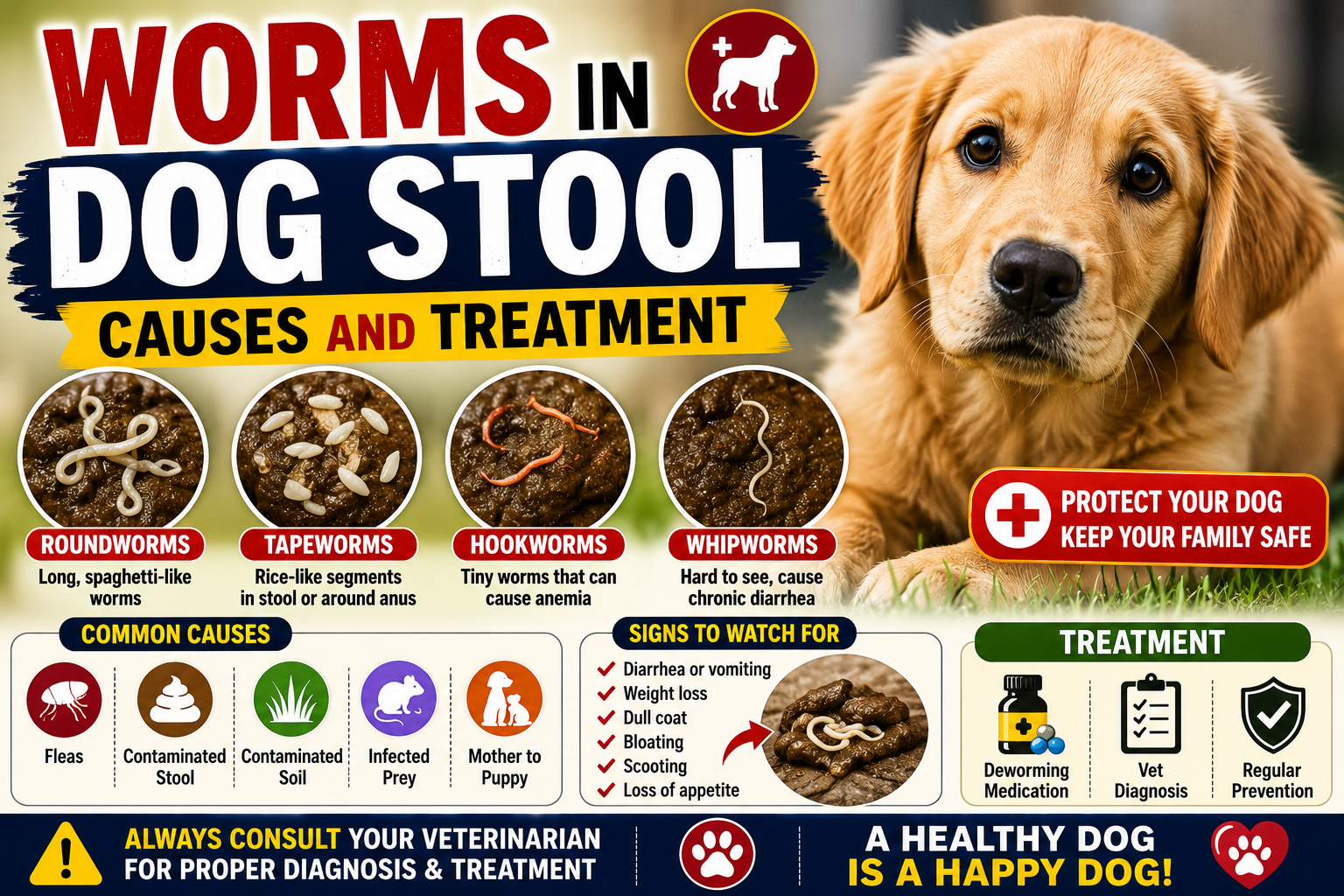
Roundworms may look like long, pale or cream-colored strands. They can sometimes be several inches long and may resemble cooked spaghetti.
They are especially common in puppies and can occasionally be seen in fresh stool or vomit.
Tapeworm Segments
Tapeworms are often noticed as small, flat segments rather than as an entire worm.
Fresh segments may look similar to grains of rice or cucumber seeds and can sometimes be found:
- In fresh stool
- Around the dog’s anus
- On bedding
- On fur around the tail
Segments may move when they are freshly passed and become dry and yellowish-white later.
Hookworms
Hookworms are much smaller than roundworms and generally cannot be identified simply by looking at a dog’s stool.
A fecal examination is usually needed to detect them.
Whipworms
Whipworms are also difficult to identify visually. Their eggs are microscopic and are detected through appropriate fecal testing.
1. Roundworms in Dog Stool
Roundworms are among the most common intestinal parasites affecting dogs.
Puppies can become infected through their mothers, while adult dogs can acquire infection by ingesting parasite eggs from contaminated environments or by eating infected hosts.
Signs of Roundworms
A dog with roundworms may have:
- Diarrhea
- Vomiting
- Weight loss
- Poor growth
- A pot-bellied appearance
- Dull coat
- Abdominal discomfort
- Reduced appetite in some cases
Some infected dogs may have few or no obvious symptoms.
Heavy infections can be particularly dangerous for young puppies.
2. Tapeworms in Dog Stool
Tapeworms are another common reason owners notice unusual material in their dog’s feces.
One of the most common canine tapeworms, Dipylidium caninum, is associated with flea exposure. Dogs can become infected by swallowing an infected flea while grooming.
This means that treating the tapeworm without addressing a flea infestation may result in reinfection.
Common Signs
Some dogs with tapeworms may show:
- Rice-like segments around the anus
- Visible segments in stool
- Scooting
- Mild digestive upset
- Weight loss in heavier infections
However, many dogs with tapeworm infections appear otherwise normal.
3. Hookworms in Dogs
Hookworms attach to the intestinal lining and feed on blood.
They can be particularly concerning in puppies because heavy infections may result in significant blood loss and anemia.
Unlike roundworms and tapeworm segments, adult hookworms are generally too small to see in normal dog stool.
Possible Symptoms
Hookworm infection may cause:
- Diarrhea
- Dark or bloody stool
- Weakness
- Pale gums
- Weight loss
- Poor growth
- Reduced energy
A puppy with pale gums, severe weakness, bloody diarrhea, or collapse needs prompt veterinary attention.
4. Whipworms in Dogs
Whipworms live in the large intestine. Their eggs can survive in the environment for long periods, allowing dogs to become infected after ingesting contaminated material.
Symptoms may include:
- Chronic diarrhea
- Mucus in stool
- Blood in stool
- Weight loss
- Dehydration
- Reduced appetite
Whipworms are not usually visible in the stool, so laboratory testing is important when infection is suspected.
Why Does My Dog Have Worms?
There are several ways dogs can become infected with intestinal parasites.
Contaminated Soil
Dogs can accidentally ingest parasite eggs or larvae while sniffing, licking, or eating contaminated soil.
Infected Feces
Parasite eggs can contaminate environments where infected animals have defecated.
Fleas
Fleas can transmit certain tapeworm infections when dogs swallow infected fleas.
Infected Animals
Dogs that hunt or eat rodents, wildlife, or other animals may have increased exposure to certain parasites.
Mother-to-Puppy Transmission
Some parasites can be transmitted from a mother to her puppies before or after birth, depending on the parasite.
This is one reason puppy parasite prevention is particularly important.
Symptoms of Worms in Dogs
The symptoms depend on the parasite, the number of worms, and the dog’s age and health.
Potential symptoms include:
- Worms or segments in stool
- Diarrhea
- Vomiting
- Weight loss
- Bloated abdomen
- Poor growth
- Dull coat
- Scooting
- Increased appetite
- Reduced appetite
- Coughing with certain parasite infections
- Pale gums
- Weakness
- Blood or mucus in stool
Importantly, a dog can have intestinal parasites without showing obvious symptoms.
Routine veterinary testing and parasite prevention are therefore important even when your dog appears healthy.
How Are Worms in Dog Stool Diagnosed?
If you notice suspected worms, contact your veterinarian and, if possible, take a fresh stool sample.
Your veterinarian may recommend a fecal examination to look for parasite eggs or other evidence of infection.
Testing methods can include:
- Fecal flotation
- Microscopic examination
- Antigen testing
- Molecular/PCR-based testing
- Other parasite-specific diagnostic tests
Different tests detect different parasites, and a single negative test does not necessarily rule out every possible infection.
Take a Photo
If you see something unusual in your dog’s stool, taking a clear photograph can be helpful.
You can also ask your veterinarian whether you should bring a fresh stool sample for testing.
Treatment for Worms in Dog Stool
The best treatment depends on the specific parasite.
There is no universal dewormer that treats every intestinal worm.
Veterinarians may use medications containing active ingredients such as:
Pyrantel
Pyrantel is commonly used against certain roundworms and hookworms.
Fenbendazole
Fenbendazole is used against several intestinal parasites, depending on the product and diagnosis.
Praziquantel
Praziquantel is commonly used to treat several types of tapeworms.
Combination Products
Some veterinary parasite products combine multiple active ingredients to provide protection against several parasites.
The correct medication, dose, and treatment duration depend on the dog’s weight, age, parasite type, health status, and specific product.
Do Not Guess the Dewormer Dose
One of the most important safety rules is to avoid calculating a dewormer dose from a random internet chart.
Different products can have different:
- Concentrations
- Active ingredients
- Approved age ranges
- Weight requirements
- Treatment schedules
- Parasite coverage
For example, a medication used for tapeworms may not adequately treat whipworms, while a medication effective against roundworms may not eliminate every type of parasite.
Always follow the product label or your veterinarian’s instructions.
Can You Treat Worms at Home?
Some dog dewormers are available without a prescription, but that does not mean every case should be treated without veterinary guidance.
Home treatment may be inappropriate when:
- The dog is very young
- The dog is pregnant or nursing
- The dog is sick or underweight
- There is blood in the stool
- The dog has repeated vomiting
- The dog is severely lethargic
- The parasite has not been identified
- Symptoms continue after treatment
- The dog takes other medications
A veterinarian can determine whether a fecal test or specific treatment is necessary.
What About Puppies With Worms?
Puppies are particularly vulnerable to intestinal parasites.
They may acquire parasites from their mother or contaminated environments, and heavy infections can cause serious health problems.
Signs of a significant parasite burden in a puppy can include:
- Poor weight gain
- Diarrhea
- Vomiting
- Bloated abdomen
- Weakness
- Pale gums
- Dehydration
- Poor appetite
Puppies should follow a veterinarian-recommended parasite prevention and deworming schedule.
Do not use an adult dog’s dewormer or dose for a puppy unless the product is specifically approved for the puppy’s age and weight.
Can Worms in Dog Stool Go Away on Their Own?
It is not a good idea to assume that intestinal worms will disappear without treatment.
Some infections may persist, and dogs can continue contaminating the environment with parasite eggs.
In addition, untreated infections can sometimes become more serious, particularly in puppies or dogs with heavy parasite burdens.
If you see worms or suspicious segments in your dog’s stool, veterinary advice can help determine the appropriate treatment.
How to Prevent Worms in Dogs
Treatment is only one part of parasite control. Prevention helps reduce the chance of reinfection.
1. Pick Up Dog Poop Quickly
Promptly removing feces from yards, sidewalks, and public areas can reduce environmental contamination.
2. Use Flea Prevention
Consistent flea control is particularly important for dogs that have had tapeworm infections.
3. Keep Your Dog From Eating Unknown Feces
Preventing dogs from eating animal or dog feces can reduce exposure to parasites.
4. Maintain Regular Veterinary Care
Routine fecal testing and parasite prevention can help identify infections before they become severe.
5. Wash Bedding
Regularly clean your dog’s bedding, especially if your dog has recently been diagnosed with parasites.
6. Keep Living Areas Clean
Clean food and water bowls regularly and maintain good hygiene around your dog’s sleeping and eating areas.
Can Dog Worms Infect Humans?
Yes. Some canine intestinal parasites are zoonotic, meaning they can infect humans.
Certain roundworms and hookworms are among the parasites that can pose a human health risk.
Good hygiene can reduce exposure.
Protect Your Family
- Wash your hands after handling dog feces.
- Pick up stool promptly.
- Keep children away from areas contaminated with dog waste.
- Wash hands before eating.
- Keep your dog’s parasite prevention up to date.
- Avoid allowing dogs to lick faces immediately after outdoor activities.
Families with young children or people with weakened immune systems should be particularly careful about hygiene and veterinary parasite control.
When Are Worms in Dog Stool an Emergency?
Most intestinal worm infections require veterinary treatment, but some symptoms require more urgent attention.
Seek prompt veterinary care if your dog has worms along with:
- Pale or white gums
- Severe weakness
- Collapse
- Repeated vomiting
- Bloody or black stool
- Severe diarrhea
- Difficulty breathing
- Severe abdominal swelling
- Signs of dehydration
- Refusal to eat or drink
Puppies can become seriously ill from heavy parasite infections, so concerning symptoms should not be ignored.
Frequently Asked Questions
Why are there worms in my dog’s poop?
Your dog may have intestinal parasites acquired through contaminated soil, feces, infected animals, fleas, or mother-to-puppy transmission. The exact cause depends on the type of worm.
What do tapeworms look like in dog poop?
Tapeworm segments often look like small grains of rice or cucumber seeds. They may be seen in fresh stool or around the dog’s anus.
What do roundworms look like in dog stool?
Roundworms can appear as long, pale, spaghetti-like worms. However, laboratory testing is still recommended to confirm the parasite.
Can I give my dog a dewormer without seeing a veterinarian?
Some products are available over the counter, but the correct medication depends on the parasite. Veterinary advice is especially important for puppies, pregnant dogs, sick dogs, and dogs with persistent symptoms.
How long does it take for worms to disappear after treatment?
The timing varies depending on the parasite, medication, and treatment schedule. Some parasites require repeated treatment or follow-up testing.
Can a dog get worms again after treatment?
Yes. Reinfection is possible if the dog remains exposed to contaminated environments, fleas, infected animals, or other sources of parasites.
Final Thoughts
Finding worms in dog stool can be concerning, but intestinal parasites are treatable when the correct diagnosis and medication are used.
Roundworms may look long and spaghetti-like, while tapeworm segments can resemble grains of rice. Hookworms and whipworms are generally not visible to the naked eye and often require fecal testing.
The safest approach is to avoid guessing the parasite or dewormer dose. Contact your veterinarian, provide a fresh stool sample or photograph when possible, and follow the recommended treatment exactly.
Regular parasite prevention, flea control, prompt removal of dog waste, good hygiene, and routine veterinary examinations can significantly reduce the risk of recurring infections.