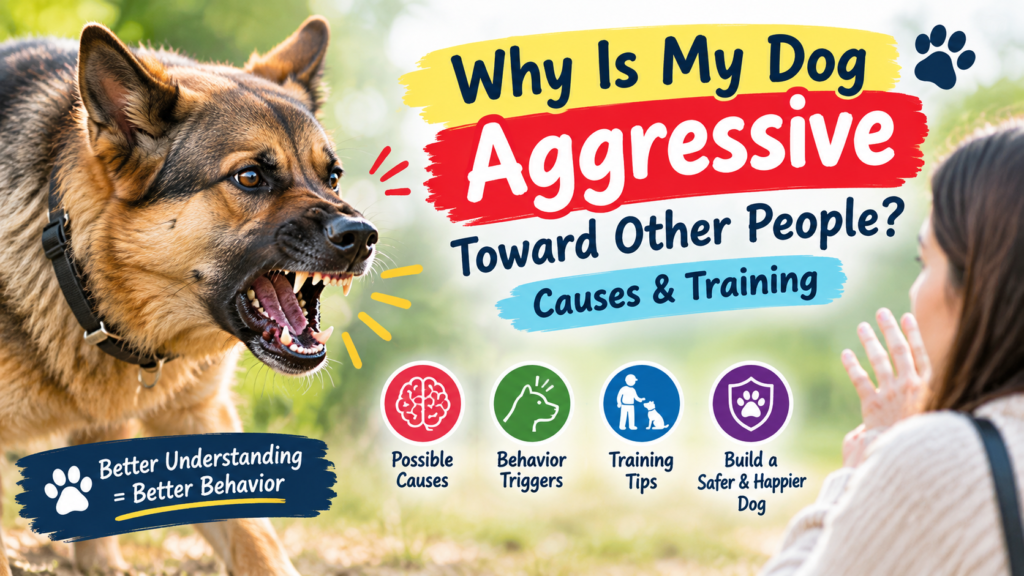

Why Is My Dog Aggressive Toward Other People? Causes, Training Tips & Solutions
Dogs are loving and loyal companions, but some dogs become angry, nervous, or aggressive when they see unfamiliar people. They may bark loudly, growl, show their teeth, pull on the leash, or attempt to bite. This behavior can be stressful for dog owners, especially when it happens during walks or when guests visit their homes.
If your dog behaves aggressively toward other people, understanding the reason behind this behavior is the first step toward improving it. Dog aggression may be associated with fear, anxiety, territorial behavior, past experiences, frustration, or medical problems.
The good news is that many dogs can learn to respond more calmly with appropriate management, patient training, and professional guidance. However, safety should always come first.
In this article, you will learn why dogs become aggressive toward people, how to recognize warning signs, and which training techniques can help your dog feel safer around others.
Key Takeaways
- Dog aggression toward people may result from fear, anxiety, territorial behavior, frustration, or pain.
- Barking, growling, stiff body posture, and lunging can indicate discomfort or a warning.
- Never punish your dog for growling or force it to interact with strangers.
- Reward-based training and gradual exposure can help improve behavior.
- Dogs that have bitten someone or may cause injury need professional behavioral assessment.
- Sudden aggression should be evaluated by a veterinarian.

Why Is My Dog Aggressive Toward Other People?
Dog aggression is not always a sign that a dog is naturally dangerous. In many cases, aggressive behavior develops because the dog feels threatened, uncomfortable, or unable to escape a situation.
Identifying what triggers your dog’s reaction can help you choose a safer and more effective training approach.
1. Fear and Anxiety
Fear is one of the possible reasons dogs react aggressively toward unfamiliar people. A frightened dog may bark, growl, or lunge because it wants the person to move away.
For example, your dog may become uncomfortable when a stranger approaches too quickly, bends over it, reaches toward its face, or attempts to touch it.
Some dogs become especially nervous around people wearing hats, carrying large objects, or moving unpredictably.
What you can do: Give your dog enough distance from unfamiliar people. Reward calm behavior when your dog notices someone without reacting aggressively. Never force your dog to accept petting.
Youtube Video
2. Territorial Behavior
Some dogs become protective of their home, garden, vehicle, or other familiar spaces. They may bark at visitors approaching the front door or react strongly when someone enters their territory.
This behavior may be intended to make the unfamiliar person move away.
What you can do: Use a secure barrier, gate, or separate room when visitors arrive. Teach your dog to go to a designated resting area and reward calm behavior. Avoid allowing your dog to rush toward guests.
3. Lack of Positive Social Experiences
Dogs learn about the world through experience. A dog that has had limited opportunities to experience different people in safe, positive situations may feel uncertain around strangers.
Negative experiences can also affect behavior. A dog that has been frightened, handled roughly, or mistreated may become defensive around unfamiliar people.
What you can do: Introduce controlled training experiences at a distance where your dog remains comfortable. Allow your dog to observe people without requiring direct interaction.
4. Resource Guarding
Some dogs become defensive when people approach something they consider valuable, such as food, treats, toys, a sleeping area, or a favorite person.
A dog may freeze, stare, growl, or snap when someone gets too close to the guarded resource.
What you can do: Keep children and visitors away from your dog’s food, toys, and resting area when guarding is a concern. Do not take items away by force or deliberately provoke the behavior. Seek help from a qualified professional who uses reward-based methods.
5. Pain or Medical Problems
A dog that suddenly becomes aggressive may be experiencing physical discomfort.
Dental disease, ear infections, joint pain, injuries, and other medical conditions can make a dog less tolerant of handling or approaching people.
What you can do: Arrange a veterinary examination if aggression develops suddenly, becomes more intense, or occurs when your dog is touched or moved.
6. Frustration and Overexcitement
Some dogs bark, pull, or lunge at people because they become overly excited or frustrated when restrained by a leash.
Although the behavior may look aggressive, its underlying cause may differ from fear-based aggression. A professional can help determine what is driving the reaction.
What you can do: Increase your distance from people, avoid crowded areas during training, and reward your dog for checking in with you and remaining calm.

Signs Your Dog May Become Aggressive
Learning to recognize early warning signs can help you prevent a situation from escalating.
Watch for these behaviors:
- Stiff body posture: Your dog suddenly becomes rigid or stops moving naturally.
- Hard staring: Your dog fixes its attention on a person and struggles to look away.
- Growling: Your dog communicates discomfort or a desire for more space.
- Showing teeth: Your dog may be warning that it feels threatened.
- Lunging or snapping: Your dog makes a sudden movement toward someone.
- Raised hackles: The hair along your dog’s back stands up, which can occur during heightened arousal.
- Attempting to escape: Your dog may hide, retreat, or try to move away from a person.
These signals must be interpreted in context. Raised hackles or barking alone do not necessarily mean a dog will bite.
If your dog looks uncomfortable, increase the distance from the person and avoid forcing further interaction.
How to Stop Your Dog From Being Aggressive Toward People
Changing aggressive behavior takes time. The safest approach combines preventing dangerous encounters with teaching your dog alternative responses.
1. Keep a Safe Distance From Strangers
Do not bring your dog close to unfamiliar people to see whether it will behave better.
Instead, find a distance at which your dog can notice people without barking, lunging, or becoming excessively tense.
If your dog reacts, calmly create more distance. Avoid crowded walkways and situations where people might suddenly approach.
The goal is to help your dog feel safe enough to learn.
2. Use Positive Reinforcement
Reward-based training encourages your dog to repeat desirable behavior.
When your dog notices a person at a safe distance and remains calm, offer a small treat or another reward your dog enjoys.
Over time, your dog can learn that seeing unfamiliar people predicts positive experiences rather than a threat.
Keep training sessions short and stop before your dog becomes overwhelmed.
3. Teach Your Dog to Focus on You
Teaching a simple attention cue can help you redirect your dog’s attention during walks.
Begin in a quiet environment with few distractions.
- Say your dog’s name in a friendly voice.
- Reward it when it looks toward you.
- Practice in different calm locations.
- Gradually introduce mild distractions.
- Use the cue around people only when your dog remains comfortable.
Do not use commands to force your dog to remain close to someone it fears. Create distance whenever necessary.
4. Avoid Punishment and Intimidation
Hitting, shouting at, pinning down, or physically intimidating a dog can increase fear and defensive reactions.
Punishing growling is especially risky because it may suppress an important warning without resolving the underlying discomfort.
Instead, focus on identifying triggers, managing the environment, rewarding desirable behavior, and obtaining professional assistance when needed.
5. Introduce People Gradually
Do not ask strangers to approach, hug, pet, or feed your dog by hand when it is showing aggression.
A qualified trainer or veterinary behavior professional can help develop a controlled desensitization and counterconditioning plan.
This involves presenting the trigger at a manageable intensity and pairing it with positive experiences while preventing the dog from becoming overwhelmed.
Progress should be gradual. Some dogs need considerable distance and time before they can comfortably tolerate unfamiliar people nearby.
6. Use Appropriate Safety Equipment
A secure, well-fitted harness and leash can help you maintain control during walks. Avoid equipment that causes pain or relies on harsh corrections.
For dogs at risk of biting, a properly fitted basket muzzle may provide an additional layer of protection when introduced gradually and positively.
A muzzle should never be used as a reason to expose a dog to frightening situations. It is a safety tool, not a treatment for aggression.

What Should You Do If Your Dog Growls at Visitors?
If your dog growls when guests arrive, do not punish it or insist that visitors approach.
Instead:
- Calmly increase the distance between your dog and the visitor.
- Use a secure gate, pen, or separate room if needed.
- Ask visitors not to stare at, touch, or crowd your dog.
- Keep children away from the dog.
- Arrange professional guidance if this behavior happens repeatedly.
Do not assume that a dog will become friendly simply because it sees the same person several times.
Some dogs may learn to tolerate familiar visitors, while others require long-term management to remain safe.
Can an Aggressive Dog Be Trained to Become Friendly?
Many dogs can improve their ability to remain calm around people, but the outcome depends on several factors.
These include the cause of the aggression, the dog’s previous experiences, the severity of its reactions, whether it has bitten someone, and the consistency of its training and management.
The goal should not necessarily be to make every dog enjoy being touched by strangers.
For some dogs, success means walking past people without reacting. For others, it means remaining safely separated from visitors or accepting a familiar person’s presence at a comfortable distance.
A qualified veterinary behaviorist or experienced reward-based behavior professional can assess your dog’s individual needs and help develop a realistic plan.
When Should You Seek Professional Help?
Seek professional assistance if your dog repeatedly growls, snaps, lunges at, or attempts to bite people.
Professional guidance is particularly important when:
- Your dog has bitten someone previously.
- The reactions are becoming more frequent or intense.
- Your dog guards food, toys, furniture, or family members.
- Children or vulnerable people live in the household.
- You cannot safely manage your dog around visitors.
- Aggression begins suddenly without an obvious explanation.
If a bite occurs, separate the dog safely and arrange appropriate medical care for the injured person. Do not attempt to physically restrain an actively aggressive dog without appropriate help.
Frequently Asked Questions
Why does my dog bark aggressively at strangers?
Your dog may be frightened, territorial, frustrated, or overstimulated. Observe the situations that trigger the behavior and create enough distance to keep your dog comfortable. A professional can help identify the cause.
Can I train my dog to stop growling at people?
You can work toward reducing the situations that cause growling by addressing the underlying emotion and teaching alternative responses. Do not punish growling, because it is a warning signal.
Should I let strangers pet my aggressive dog?
No. Avoid allowing strangers to approach or touch a dog that shows aggressive behavior. Give the dog space and prioritize safety.
Does neutering stop dog aggression?
Neutering is not a guaranteed solution for aggression. Its effects depend on the individual dog and the underlying cause of the behavior. Discuss the potential benefits and limitations with your veterinarian.
How long does dog aggression training take?
There is no fixed timeline. Some dogs show improvement with consistent training and careful management, while others require months of work or long-term safety precautions.
Why has my friendly dog suddenly become aggressive?
Sudden aggression may be related to pain, illness, fear, or a change in the environment. Arrange a veterinary examination before assuming the problem is purely behavioral.
Final Thoughts
A dog that becomes aggressive toward other people may be communicating fear, discomfort, frustration, or a need for space. Identifying the cause is essential for choosing an effective training approach.
Use positive reinforcement, avoid confrontational methods, and prevent situations in which your dog could injure someone. Never force interactions with strangers, and seek professional guidance if your dog shows serious or repeated aggression.
With a suitable management plan, patience, and expert support, many dogs can learn safer ways to respond to people. Every dog is different, so focus on realistic progress and the safety of everyone involved.